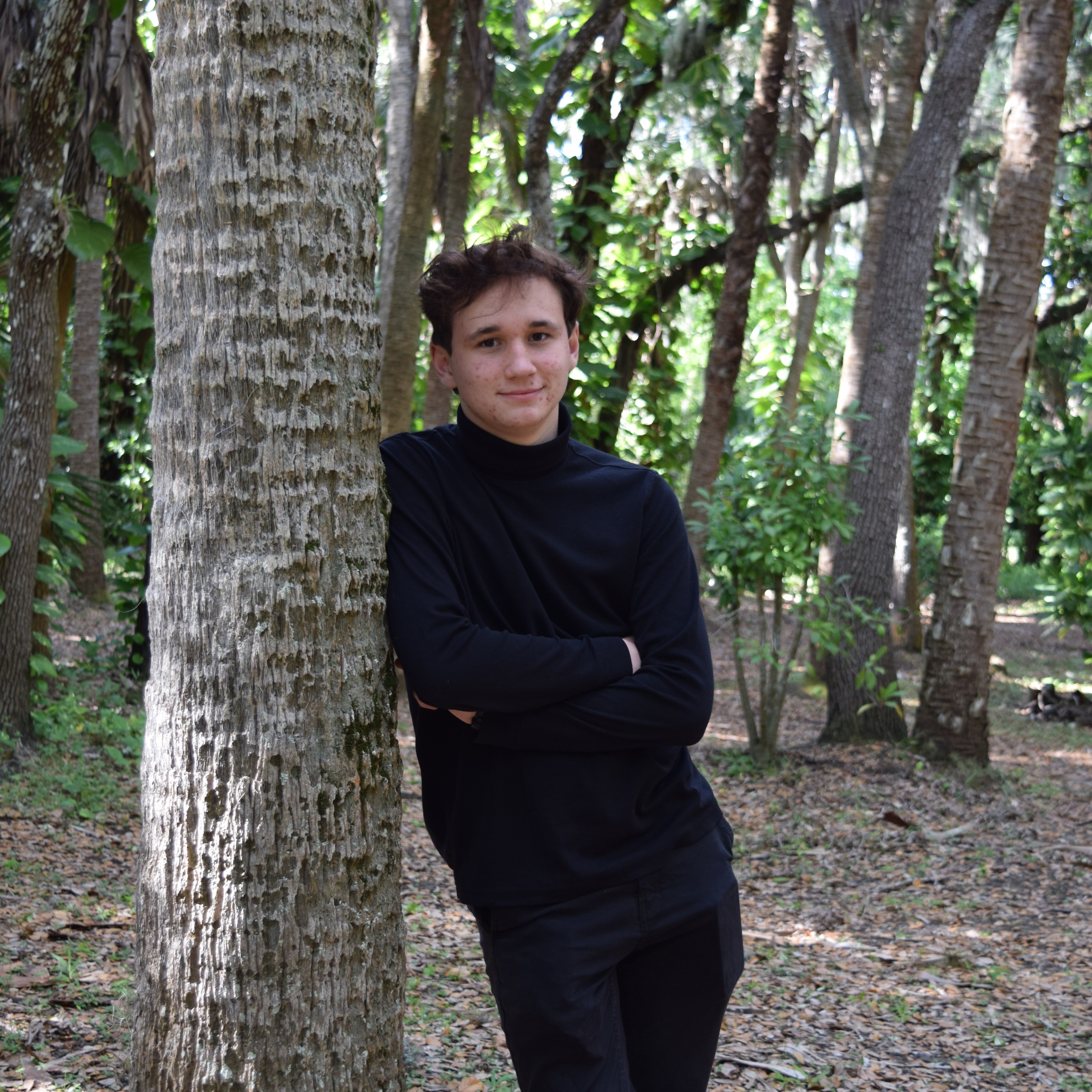
Ian Orzel


PhD Student
Advisor: Srikanth Srinivasan
Group: Basic Algorithms Research Copenhagen (BARC)
Department of Computer Science,
University of Copenhagen,
Universitetsparken 1
2100 Copenhagen Ø
I am a PhD student advised by Srikanth Srinivasan at the University of Copenhagen under the Department of Computer Science (DIKU) and Basic Algorithms Research (BARC). My research interest lies in the theory of algebraic complexity theory, which explores lower bounds and computability results on polynomial equations. For inquiries, you can reach me at iano (at) di (dot) ku (dot) dk.
Research Papers
Authors: Cornelius Brand, Radu Curticapean, Petteri Kaski, Baitian Li, Ian Orzel, Tim Seppelt, and Jiaheng Wang
Abstract: The complexity of bilinear maps (equivalently, of \(3\)-mode tensors) has been studied extensively, most notably in the context of matrix multiplication. While circuit complexity and tensor rank coincide asymptotically for \(3\)-mode tensors, this correspondence breaks down for \(d \geq 4\) modes. As a result, the complexity of \(d\)-mode tensors for larger fixed \(d\) remains poorly understood, despite its relevance, e.g., in fine-grained complexity. Our paper explores this intermediate regime. First, we give a "graph-theoretic" proof of Strassen's \(2\omega/3\) bound on the asymptotic rank exponent of \(3\)-mode tensors. Our proof directly generalizes to an upper bound of \((d-1)\omega/3\) for \(d\)-mode tensors. Using refined techniques available only for \(d\geq 4\) modes, we improve this bound beyond the current state of the art for \(\omega\). We also obtain a bound of $d/2+1$ on the asymptotic exponent of \emph{circuit complexity} of generic $d$-mode tensors and optimized bounds for $d \in \{4,5\}$. To the best of our knowledge, asymptotic circuit complexity (rather than rank) of tensors has not been studied before. To obtain a robust theory, we first ask whether low complexity of \(T\) and \(U\) imply low complexity of their Kronecker product \(T \otimes U\). While this crucially holds for rank (and thus for circuit complexity in \(3\) modes), we show that assumptions from fine-grained complexity rule out such a submultiplicativity for the circuit complexity of tensors with many modes. In particular, assuming the Hyperclique Conjecture, this failure occurs already for \(d=8\) modes. Nevertheless, we can salvage a restricted notion of submultiplicativity. From a technical perspective, our proofs heavily make use of the graph tensors \(T_H\), as employed by Christandl and Zuiddam ({\em Comput.~Complexity}~28~(2019)~27--56) and Christandl, Vrana and Zuiddam ({\em Comput.~Complexity}~28~(2019)~57--111), whose modes correspond to the vertices of undirected graphs \(H\). We make the simple but conceptually crucial observation that Kronecker products \(T_G \otimes T_H\) are isomorphic to \(T_{G+H}\), and that \(G\) and \(H\) may also be fractional graphs. By asymptotically converting generic tensors to specific graph tensors, we can use nontrivial results from algorithmic graph theory to study the rank and complexity of \(d\)-mode tensors for fixed \(d\).
Authors: Ian Orzel
Abstract: We first extend the results of Chatterjee, Kumar, Shi, Volk (Computational Complexity 2022) by showing that the degree d elementary symmetric polynomials in \(n\) variables have formula lower bounds of \(\Omega(d(n-d))\) over fields of positive characteristic. Then, we show that the results of the universality of the symmetric model from Shpilka (Journal of Computer and System Sciences 2002) and the results about border fan-in two \(\Sigma\Pi\Sigma\) circuits from Kumar (ACM Trans. Comput. Theory 2020) over zero characteristic fields do not extend to fields of positive characteristic. In particular, we show that
- There are polynomials that cannot be represented as linear projections of the elementary symmetric polynomials (in fact, we show that they cannot be represented as the sum of \(k\) such projections for a fixed \(k\)) and
- There are polynomials that cannot be computed by border depth-\(3\) circuits of top fan-in \(k\), called \(\overline{\Sigma^{[k]}\Pi\Sigma}\), for \(k = o(n)\).
Authors: Ian Orzel, Srikanth Srinivasan, Sébastien Tavenas, Amir Yehudayoff
Abstract: It is a well-known fact that the permanent polynomial is complete for the complexity class VNP, and it is largely suspected that the determinant does not share this property, despite its similar expression. We study the question of why the VNP-completeness proof of the permanent fails for the determinant. We isolate three fundamental properties that are sufficient to prove a polynomial sequence is VNP-hard, of which two are shared by both the permanent and the determinant. We proceed to show that the permanent satisfies the third property, which we refer to as the "cost of a boolean sum," while the determinant does not, showcasing the fundamental difference between the polynomial families. We further note that this differentiation also applies in the border complexity setting and that our results apply for counting complexity.
Authors: Jason Elsinger, Ian Orzel, Aaron Welters
Abstract: In this paper, we prove the following. First, every square matrix whose entries are multivariable rational functions over a field F has a Bessmertnyĭ realization, i.e., is the Schur complement of an affine linear square matrix pencil with coefficients in F. Second, if the matrix is also symmetric and the characteristic of the field F is not two then it has a symmetric Bessmertnyĭ realization (i.e., the pencil can be chosen to consist of symmetric matrices) and counterexamples are given to prove this statement is false in general for fields of characteristic two. Third, for fields of characteristic two (e.g., binary or Boolean field), we completely characterize those functions that have a symmetric Bessmertnyĭ realization. Finally, analogous results hold when restricted to the class of homogeneous degree-one rational functions. To solve these realization problems, i.e., finding such structured Bessmertnyĭ realizations for a given multivariate rational function, we use state-space methods from systems theory to produce realizations for algebraic operations on Schur complements such as sums, products, inverses, and symmetrization, which become the elementary building blocks of our constructions. Further complications arise over fields of characteristic two, so a large part of the paper is devoted to developing additional methods to decide if the symmetric realization problem can be solved and, if so, to construction the symmetric realization for a given symmetric rational matrix function. Our motivations are discussed in the context of multidimensional linear systems theory on generalizing state-space representations for rational functions including the Givone-Roesser and Fornasini-Marchesini realizations.
[Arxiv]
Talks
We present our recent theorem, and its proof, that resolves an open problem posed to me as an undergraduate by my research advisor, Aaron Welters (Florida Institute of Technology), in Jan. 2022. Our results can be summarized as follows. First, every square matrix whose entries are multivariable rational functions over a field \(F\) in \(n\) indeterminates \(z1,…,zn\) has a Bessmertnyi realization, i.e., is the Schur complement of an affine linear square matrix pencil with coefficients in \(F\) . Second, if the matrix is also symmetric and either \(n=1\) or the characteristic of the field \(F\) is not two then it has a symmetric Bessmertnyi realization (i.e., the pencil can be chosen to consist of symmetric matrices). For all other cases (i.e., when \(n≥2\) and the characteristic of \(F\) is two), we give counterexamples and, in particular, show there is a class of multivariate rational functions that cannot be synthesized from the response matrix of any reciprocal electrical network over fields of characteristic two (e.g., Boolean networks). A specific example of this is given that illustrates the result using the Y -Δ transform. Finally, we conclude with a complete characterization of the class of functions with symmetric Bessmertnyi realizations. This is joint work with Jason Elsinger and Aaron Welters.
Other Writings
We study foundational and recent results in algebraic complexity theory re- lated to the singular loci of polynomials, the Hessians of polynomials, vanishing subspaces on polynomials, and projections of elementary symmetric polynomi- als. Specifically, we study how these results are influenced by the characteristic of the underlying field as well as whether they hold in the border complexity setting. We study representing polynomials as projections of the elementary symmetric polynomials and find that not all polynomials can be represented in this way over fields of nonzero characteristic. This result also works in the border setting. We further study the singular loci of the elementary symmetric polynomials over fields of nonzero characteristic, allowing us to generalize some results that were only known to be true over characteristic zero. We finally study and obtain partial results when considering some of these methods in fields of nonzero characteristic and in the border setting.
[Text]
[Text]
[Text]